I went on my first long hike since moving to Bozeman the other day.
I'd made plans with a woman I've recently met—an inspiring outdoorswoman, a total badass who loves to "get after it." I wanted to spend time with her, get out into the mountains, and experience something new. When we made our plans, snow wasn't in the forecast. But this is Montana. It's late October. As I'm learning, snow is possible here just about any time of year.
I was grateful to have someone who knew the terrain leading the way: a trusted guide.
There was a lot to take in. A full-bodied sensory immersion. Snow-covered pines, white peaks against a brilliant blue sky, sunlight breaking through the trees, cold mountain air, and a landscape that literally sparkled in every direction.
Of course, hiking in snow required a few adjustments. Don't get me wrong, I'm no stranger to the outdoors. I spent time doing wilderness therapy in Colorado and have some experience in winter conditions. But I'm also not 25 anymore, and here I am, finding my footing in a new place.
Different terrain. Different equipment. More attention to where I placed my feet. A different pace. A willingness to move differently.
And what an experience it was.
Nothing changes if nothing changes: how we approach change matters
I've been thinking a lot lately about change and growth, and what it means to do things differently. All the things I support people through in my work as a therapist.
Moving across the country has certainly given me plenty of practice. New surroundings. New relationships. New routines. New ways of doing things.
And this particular hike was another chance to step outside what's familiar. Not because something was wrong or needed fixing. I simply wanted the experience.
There's an old saying: Nothing changes if nothing changes.
There's truth in that. But I wonder how often we interpret change to mean doing more, trying harder, or pushing ourselves beyond what's comfortable.
Sometimes change is something we actively seek. Other times, life presents us with circumstances that require us to adjust. Either way, we may find we have more choices.
And doing things differently doesn't always mean doing more.
Sometimes it means approaching something with more curiosity, more flexibility, or a different kind of support. Sometimes it means slowing down, paying attention, or learning to stay with discomfort rather than immediately trying to make it go away.
I've come to believe that how we approach change matters just as much as what we're hoping to change. It’s not about becoming someone new. It’s about finding more freedom to be ourselves.
And perhaps that's the art of adjusting.
The science of change: why old patterns stick
Our brains are remarkably adaptable. They're shaped by experience, and they continue to change through experience. This capacity, known as neuroplasticity, allows us to learn, adapt, and develop new ways of responding throughout our lives.
But we're also exceptionally good at repeating what's familiar. Over time, patterns of thinking, feeling, and behaving can become so automatic that we barely notice them.
And there's a reason for that. Many of these patterns developed as ways to protect ourselves, maintain connection, manage discomfort, or simply get through difficult life experiences. They served a purpose. And when something works, even if only in the short term, we're inclined to repeat it.
Think of saying yes when you actually mean no, dating what feels like the same person over and over again (different person, same familiar dynamic), or staying so busy you never have to sit still.
Ever reached for your phone, food, a drink, or a little shopping to escape an uncomfortable feeling? I have. Plenty of times.
Wanting relief from discomfort is deeply human. But what’s familiar isn’t always what’s helpful. In fact, the very strategies that once helped us cope may now be getting in our way. Some coping strategies, it turns out, come with an expiration date.
If you’ve ever felt stuck, you’re not alone. Therapy can help us recognize these patterns, but insight alone doesn’t necessarily change them. We can understand exactly what we’re doing and still find ourselves doing it. Frustrating, even maddening. I get it.
Sometimes understanding the pattern isn't enough. We need an opportunity to experience something different.
An opportunity to respond in a new way. To discover that something unfamiliar is manageable. That discomfort doesn't always mean danger, asking for support doesn't mean we're incapable, and slowing down doesn't mean we're falling behind.
Those "icky and sticky" feelings, as I call them, can offer valuable information. Sometimes they're telling us something needs our attention or care. Other times, they're simply part of trying something new. Learning to recognize the difference is part of the work.
And nature offers an extraordinary place to practice. Conditions change. Plans shift. Sometimes we’re asked to pay closer attention, move differently, or let go of how we thought things would unfold. There’s room to experiment. To try something new. To discover that other possibilities exist.
After all, the unfamiliar becomes familiar one experience at a time.
We need enough safety to explore: what attachment theory teaches us about change
Think about children. They're naturally curious about the world. They reach, wander, experiment, and ask question after question. And when they have a trusted, responsive caregiver to return to, they're often more willing to venture out and explore.
Attachment theory calls this a secure base.
That sense of security doesn't eliminate uncertainty. It provides a relationship from which curiosity and exploration become more possible.
And we don't outgrow our need for that kind of safe, secure connection. Ever. We're wired for connection throughout our lives.
Somewhere along the way, many of us learned to equate independence with doing everything ourselves. But self-reliance and interdependence aren't mutually exclusive. We can trust our own capabilities while also allowing ourselves to lean on others. In fact, sometimes it's the presence of a trusted other that gives us the confidence to venture somewhere new. There are plenty of things we must do on our own, and things we're meant to do with support. Recognizing the difference takes discernment. Allowing ourselves to receive support can take practice.
The relationship matters most: on the trail or in the office
At NOURISH here in Bozeman, my approach is integrative, experiential, and embodied. In plain terms, I draw on more than one way of working, and we don’t just talk about change; we practice it. Some sessions happen in the office and others on the trail, as walk-and-talk therapy, all of it informed by attachment theory, trauma-informed care, and somatic practice. That blend is part of why my work as a therapist looks a little different. We pay attention to what happens when we move, when we slow down, when we try something new, or when we resist the urge to do anything at all.
But the setting is only part of it. What matters most is the relationship and the conditions we create together. The opportunity to be curious rather than critical, to experiment rather than perform, and to discover that we can approach ourselves, our relationships, and our experiences differently.
The work isn't about pushing people beyond what feels safe. It's about creating enough safety, trust, and choice to explore what's possible.
The trail was a good reminder.
Our need for safety isn't an obstacle to growth. It's what allows us to begin. I don't know that I would have ventured into those snowy mountains, on a trail I'd never traveled, without someone who knew the terrain. Having a trusted guide didn't take away the challenge. It made the experience feel possible. The trail still required me to find my footing. I still had to take every step myself, to pay attention, to move differently.
On this hike, I didn’t want to find my way alone.
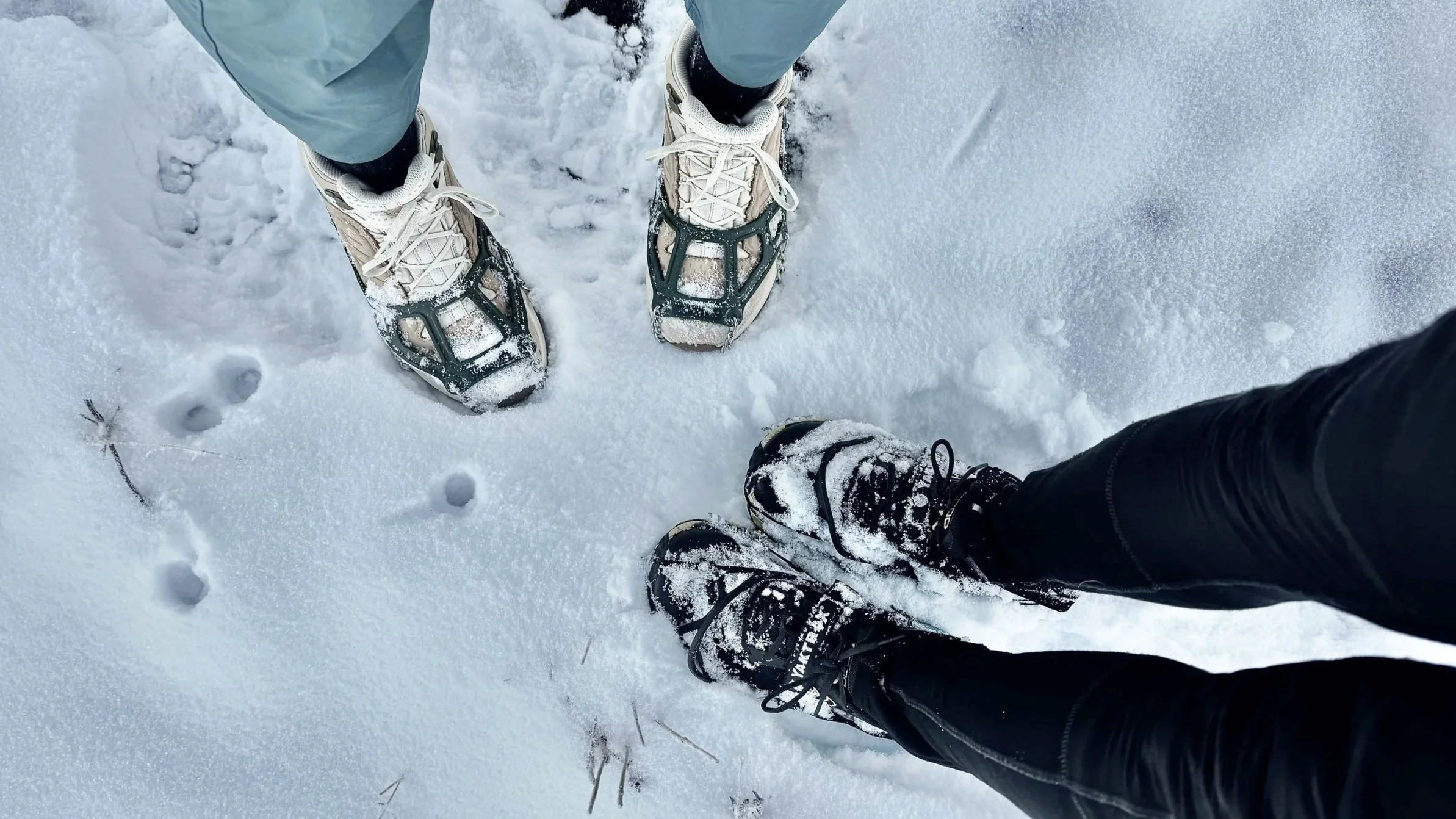
With my trusted guide.
If you're curious what walking alongside someone could look like, I offer in-person and walk-and-talk sessions in Bozeman, and virtual sessions in Montana, Massachusetts, and Rhode Island. The first step is a free 15-minute conversation. Book a call